Are You a Ferrari or a Honda Accord?
a hierarchy of cars and people

Hierarchy
Because I have idiosyncratic tendencies that the world would like to classify as autistic, I have “special interests”, and I am driven to categorize.
Two of my “special interests” are social stratifications and cars. These are two complex hierarchical systems.
Because I have idiosyncratic tendencies that the world would like to classify as schizoid, I have an unconscious compulsion to recognize and match patterns.
These two complex hierarchical systems (social stratifications and cars) have begun to overlap in my brain.
So I’d like to present you with a heuristic I’ve been using to categorize the people I encounter into neat little containers.
The model goes like this:
In the same way that human intelligence is distributed in standard normal bell curve hierarchy, the performance capacity of cars is distributed in a hierarchy that resembles a bell curve.
The models converge.
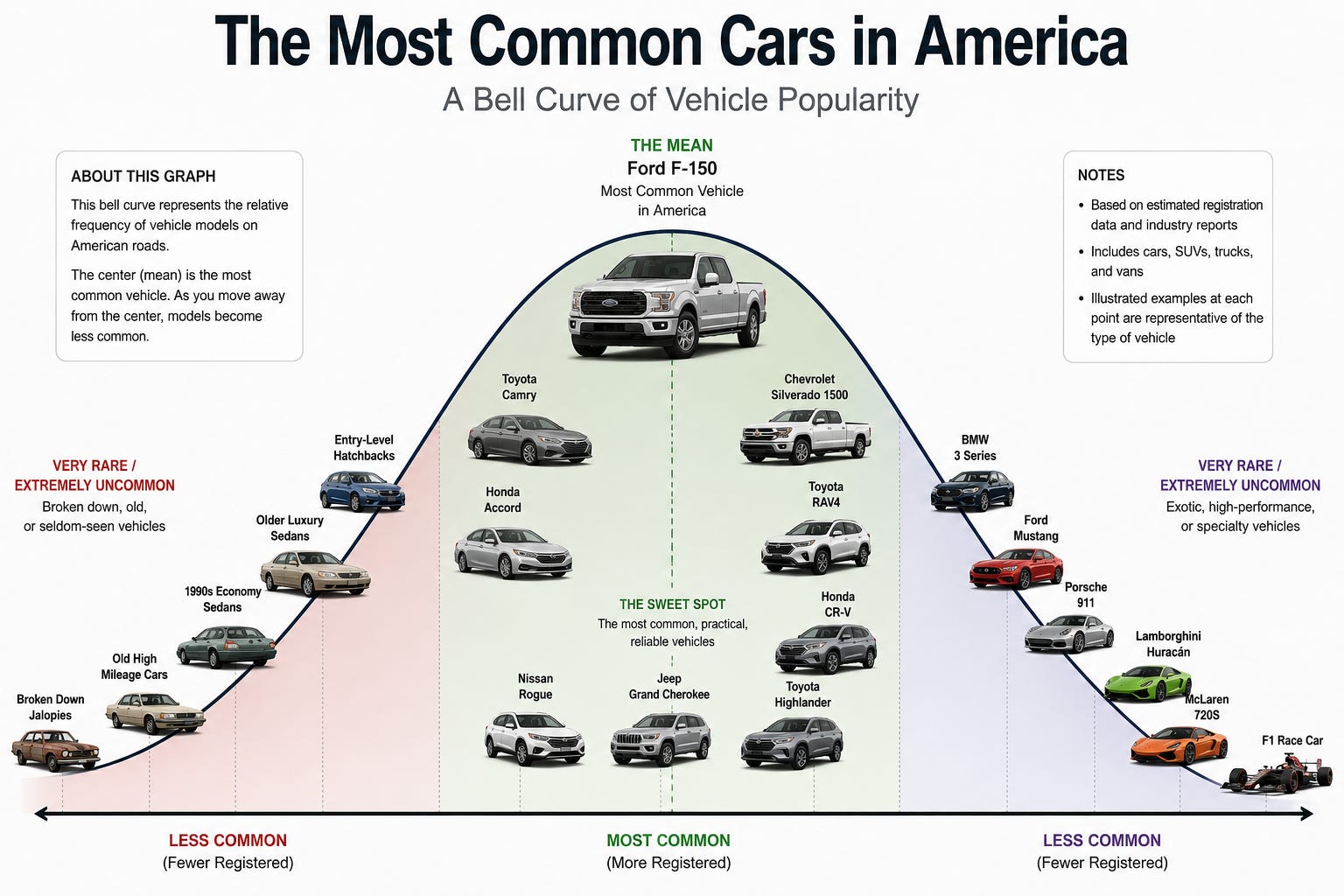
Once I noticed this, I couldn’t help but start sorting case studies in real time.
We have several categories:
Rust buckets
Jalopies
Commuter cars
Luxury cars
Performance vehicles
Sports cars
Super cars
Hyper cars
F1
You’ll notice my bell curve is a little lopsided with these categories, but you’ll have to bear with me. I make a habit of trying to socialize with the smartest people I can convince to speak with me, so my dataset of individuals leans heavily towards the right side of the graph. Thus, I differentiate and stratify the right side of the graph moreso than the left.
But just because I don’t encounter many individuals of startlingly low intelligence doesn’t mean I’m not certain they’re out there, just as I am certain there are plenty of dilapidated vehicles rusting away happily in little junkyards strewn across the world, even if I don’t see them on the road.
But that’s enough introduction. Let me elucidate the model further.
Rust buckets
I do not want to spend much time mapping rust buckets into the model because it would make the whole framework feel cruel. It needs to be here as a counterballast, but dissecting these minds feels in poor taste.
The world needs the work truck that just keeps on trucking, no matter what.
The world needs people to lay bricks and collect grains.
We love rust buckets.
Jalopies
This is your friend or family member or classmate or coworker who you love quite dearly, but for the life of you, you cannot remember a single conversation with them that penetrated beneath pleasant shallow tautologies. You may, however, have had a good conversation with them— because they were willing to listen intently, and simplifying complex concepts into something a child can understand is a fun game to play.
This is also the source of your frustration when the labor of a group effort gets distributed in a bizarre and unequal manner. This is the source of your frustration and despair when you look at our system of governance and realize “holy shit, these people vote too.”
I love a good jalopy. It has spirit. It has grit. The world is a brutal place and the jalopy keeps on running, spare bolts, rust and all. There is a certain kind of beauty when you see one rolling down the street; you can’t help but smile.
Commuter Cars
Ford F150, Honda Accord, Toyota Prius, Nissan Altima, etc.
The commuter car exists at the center of the bell curve. If you were to walk into a room of 1000 people selected to portray a standard normal distribution, this would be the majority of the people you would encounter.
The commuter car gets the job done. I must assume they live good, full lives, because it is hard to build social infrastructure that does not cater to the mean, even if you want to reward hierarchical outliers.
This is probably the category that is the hardest for me to understand.
The problem with the mean is that it is beige. It is so overwhelmingly normalized that it is hard to discern enough differentiating factors to build a true understanding.
It is around this median that I should probably briefly explain what my conception of intelligence actually consists of.
I believe intelligence is a metric of capacity. This capacity is incredibly vague and amalgamous, but I’ve come to understand through this formula:
Intelligence is an innate capacity for range, depth, and adaptivity— splayed upon parallel axes of cognition (mentalistic vs mechanistic, lateral vs vertical, right brain vs left brain, chaotic vs orderly, generative vs reiterative, openness to experience vs conscientiousness, creativity/innovation vs structure/form, etc. etc.).
The formula is (range+depth+adaptivity) x (predisposition towards mentalism or mechanism).
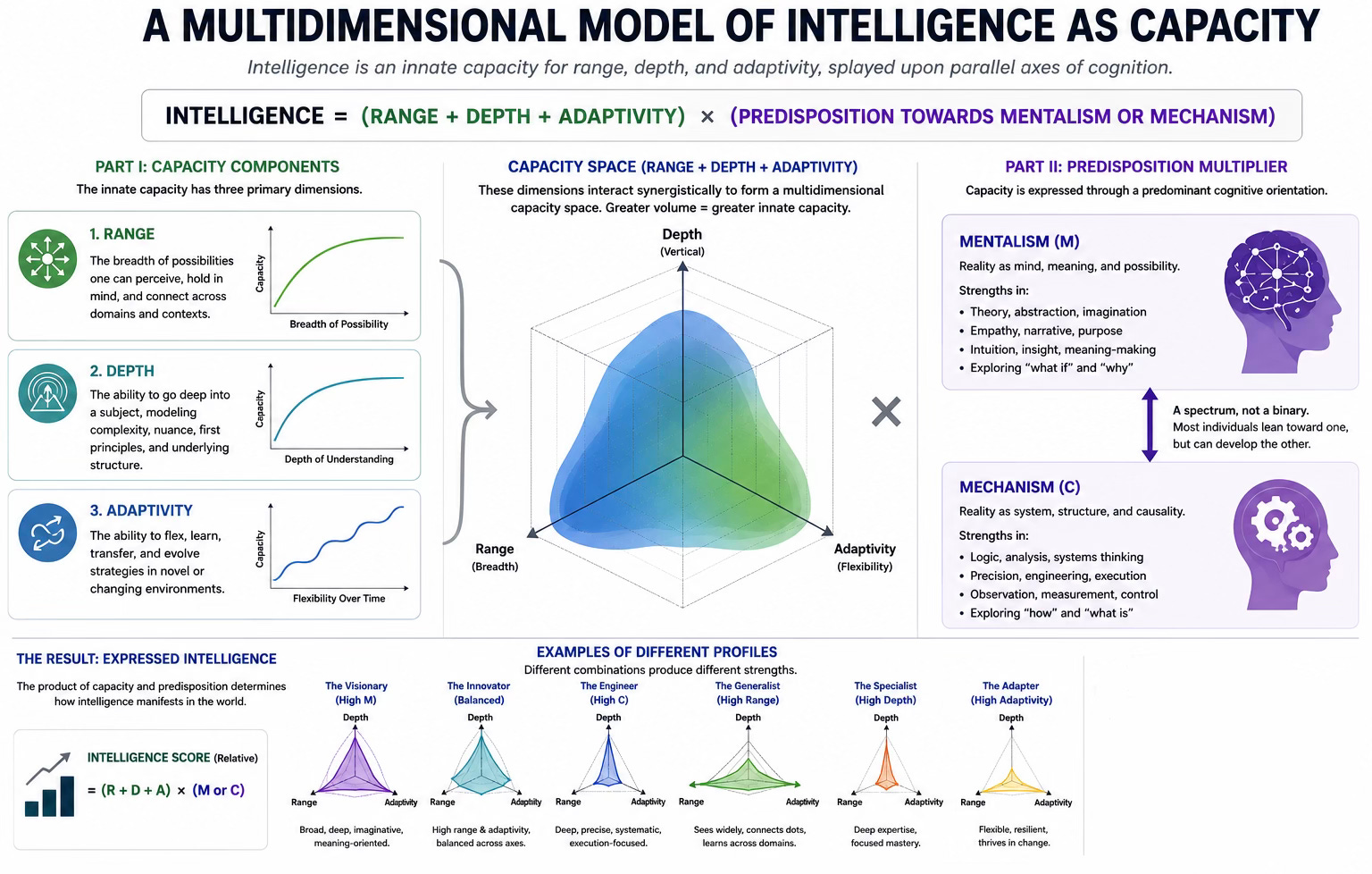
I believe this capacity is somewhat determined by genetic potential, but environmental impacts shape and catalyze it into the engine and vehicle it becomes.
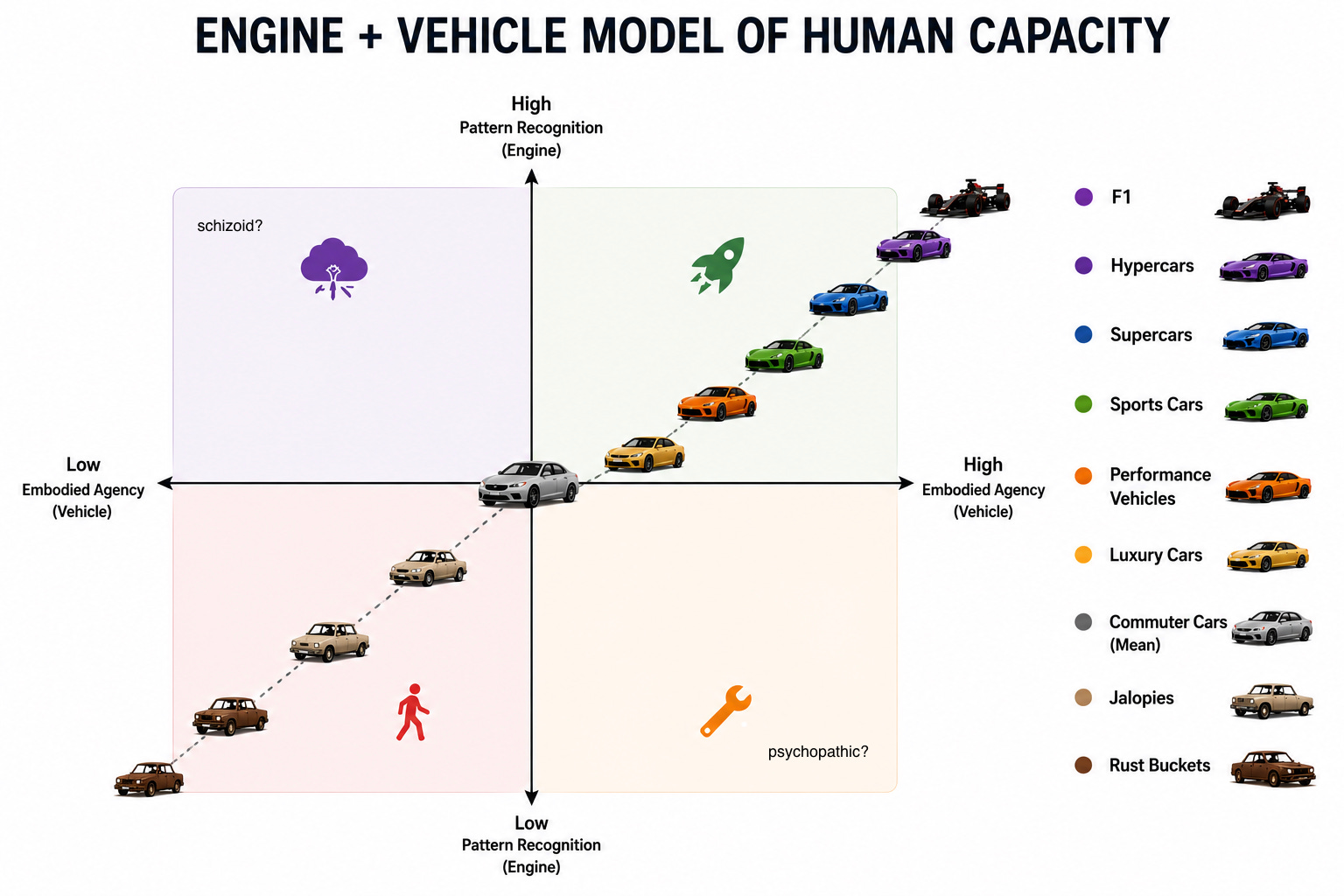
Humans are {pattern recognition engines} (M) and {embodied action vehicles} (C). Intelligence is what arises when those two capacities meet and entwine.
Neurological and psychological disorder is what arises when the engine and the vehicle are not in balance.
Past the mean, the engine and the vehicle begin to hum in synchrony.
Luxury Cars
BMW, Mercedes Benz, Lexus, etc.
These vehicles have the luxury to capitalize on the way our infrastructure caters to the mean, but they have enough horsepower to end up on the right end of the stick, time and time again.
The B+, A- student who has their wits about them enough to take the world for all she is worth, skating past the traps that most commuter cars fall into, while still being perfectly engineered to drive on commuter terrain.
I must assume these folks live good, full, incredibly human lives, because this heuristical archetype is what our current social infrastructure actively rewards.
I must also assume that it can be very hard to live in this frame, because everything should be running smoothly, but it actually isn’t. I think this is more of an infrastructure problem than an individual problem, but I digress.
Performance Vehicles
AMG, M badge BMW, Abarth, Mopar (specifically Hellcat emblem), etc.
The performance vehicle is where we start to see some outliers. Folks who know not just how to avoid the pitfalls that the commuter cars fall into, but how to avoid them with speed, grace, and velocity. This person has the horsepower to form novel interactions between the {pattern recognition engine} and the {embodied action vehicle}.
This is where you get your entrepreneurial business owner, your financially and emotionally stabilized artist, your corporate executive with a clean cut suit and tie.
But after this point, things start to get a little nonsensical.
Sports Cars
Porsche, Lotus, Corvette, etc.
When we get into the territory of sports cars, we have to start asking ourselves— why does this machine even exist?
It’s not convenient. It’s not reliable.
And yet— there is nothing like a drive through the canyons in a Porsche 911.
This is where you start to see abnormalities. People who seem to just have life figured out in a way that is impossible for the rest of us to grasp. People who aren’t just smart, but agentic, driven and disciplined. People who are odd, who live life differently— but someway, somehow, the world ends up winding itself around their pinky finger.
Supercars
Lamborghini, Ferrari, McLaren, GT3RS, etc.
The dataset of Supercars refers to individuals who could be described as “once in a generation”.
This is where you get the Visionary CEO. The not-so-emotionally-stabilized, but most-certainly-financially-rewarded Artist. This is the place where the {generative, creative, innovative pattern recognition engine} meets the {disciplined, autonomous, driven embodied action vehicle} in a harmony that has international impact.
This is where these upper echelons start getting truly exclusive. While general cognitive capacity is approximately normally distributed, civilizational impact becomes Pareto-distributed.
As velocity concentrates further, things begin to get particularly odd.
Hypercars
Koenigsegg, Pagani, Bugatti, etc.
When we get to hypercars, nonsensical no longer serves its purpose as a word to describe what we are looking at. Reliability and convenience were never even a part of the conversation.
This is where we begin to see true outliers.
The thing about hypercars is that they have such a capacity to tangle with informational complexity that they begin to operate in domains of value that supersede the institutional infrastructures that cater to the mean.
This is where you get your reality defining physicists and mathematicians. Your revolutionary sociopolitical economists. Your visionary computer engineers. Your groundbreaking scientists, your world-changing inventors, and your paradigm defining artists and philosophers.
The hypercar is the true genius. The mind that humanity would not look the same without.
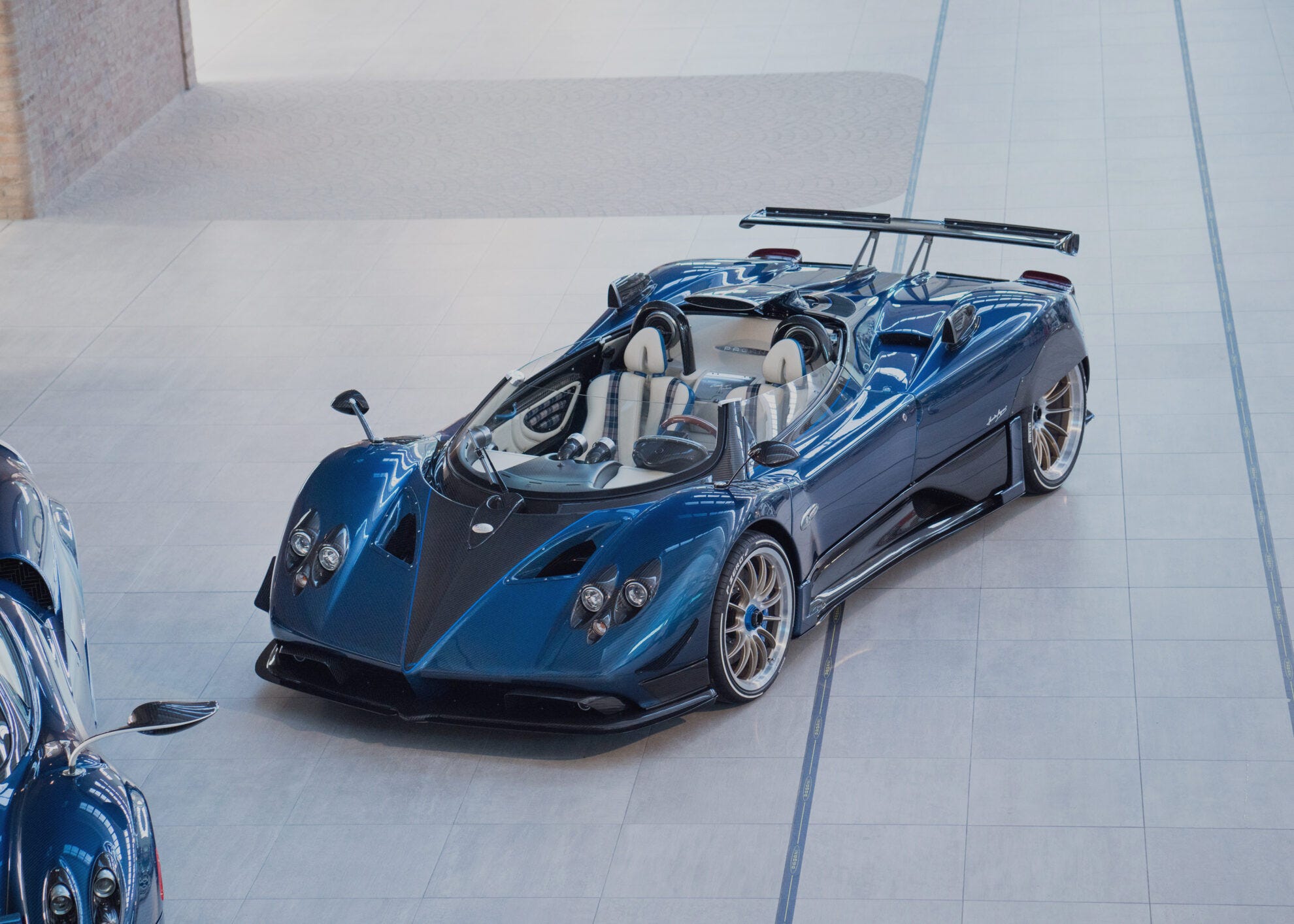
These are people who dedicate their entire lives to a kind of intellectual labor that is unrecognizable by the commuter cars running down the street. We do not understand them, but we cherish them— because their labor has laid down groundworks of understanding that allow us to operate and interact with the world in a more dynamic, informed, and thus agentic manner.
But there is still one more echelon to go.
F1
The Apex of Velocity
There is a point at which the capacity to wrestle with informational complexity reaches the physical limit to what our hardware can support. Where the bridge between the {pattern recognition engine} and the {embodied action vehicle} is woven together into a vessel that impacts the shape of civilization for centuries and millennia to come.
This is where you get The Buddha. This is where you get The Christ, The Prophet Muhammad, Confucius, and all the other vehicle-vessels that have fundamentally shaped the world we live in today.
F1 is not merely higher IQ or larger agency. It is contact with transpersonal symbolic truth at a scale where the person becomes a vessel for civilization’s self-understanding.1
These are vehicles that are operating in domains of Value that can easily turn unintelligible to the mean.
I must be honest— this model has been developed in a subconscious attempt to better understand social friction.
If you drop an F1 racecar into standstill traffic, it will suffer. It is not built to stop and start and stop and start and stop and start 47 times within the span of ten minutes.
That thing wants to fucking scream.
It wants to roar.
It wants to sing.
It wants to devour oxygen and rubber and pavement— it wants to fly.
In traffic? It can seem damn near useless.
It appears incredibly inconvenient to the other cars trying to drive down the street.
The F1 vehicle is capped by the context in which it is placed. So are all other vehicles. Each is built for a different purpose, built for different environments and different tasks.
Edward Teller said of John von Neumann:
“Von Neumann would carry on a conversation with my three-year-old son, and the two of them would talk as equals, and I sometimes wondered if he used the same principle when he talked to the rest of us.”
Every vehicle has to figure out how to drive the surface streets and highways that carry all of us throughout the world.
And it is my sinking suspicion that today, right now, there are far too few racetracks that let machines built for stupendous velocity run wild and free, in glorious competitive collaboration with one another.
…so how do we build these raceways?
The answer to that question lies partially in my most recent essay, but I have another piece cooking up in which I get to play with this racetrack heuristic that we now share. If you don’t want to miss it, please
or
I think my ego might be outta control
this was vehemently motivational. besides using IQ as a reliable metric. I gotta be an F1